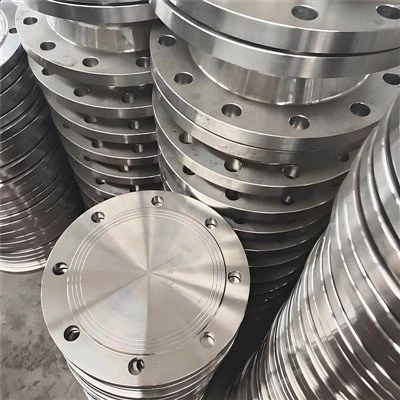
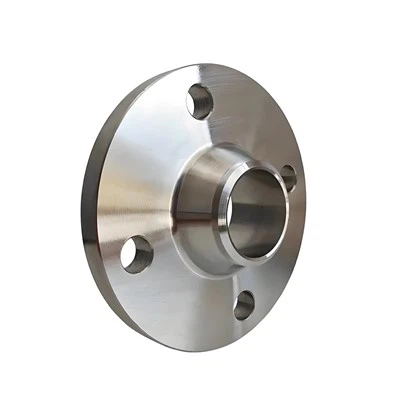
The carbon steel slip on flange is a forged piping component engineered to slide over the end of nominal pipe sizes before being secured via double fillet welds. Combining the economic machinability of carbon steel with the installation flexibility of a low-hub slip-on profile, this flange provides a dependable joint solution for non-corrosive fluid, gas, and utility piping systems operating under moderate thermal and mechanical stress.
Structural & Mechanical Characteristics
Sliding Fit Bore Machining
The internal bore of the carbon steel slip on flange is machined to precise inside diameter tolerances (typically +0.03 in / +0.8 mm over nominal pipe OD), allowing seamless sliding over the pipe exterior without binding or galling against the forged carbon steel body.
Low-Hub Compact Profile
The forged transition hub features a low axial height compared to standard weld neck profiles. This low envelope reduces overall weight, lowers raw forging mass, and minimizes physical interference in tight manifold skids and compact valve banks.
Fillet-Welded Load Transfer
Mechanical restraint and boundary sealing are established through two external/internal fillet welds. The forged carbon steel provides stable base-metal chemistry that promotes clean weld dilution with standard E7018 electrodes or ER70S-6 filler wires.
Axial Alignment Flexibility
Because the flange slips over the pipe rather than butting against an exact bevel end, field fit-up crews can adjust orientation and bolt-hole straddling without re-cutting or beveling pipe ends.
Technical Specifications & Carbon Steel Grades
|
Parameter |
Engineering Specification |
|
Manufacturing Standards |
ASME B16.5, ASME B16.47 Series A/B, DIN EN 1092-1 Type 01/12, BS 4504 |
|
Size Range |
NPS 1/2" through NPS 24" (ASME B16.5); NPS 26" through NPS 60" (ASME B16.47) |
|
Pressure Ratings |
Class 150, Class 300, Class 600, Class 900, Class 1500; PN 6, PN 10, PN 16, PN 25, PN 40 |
|
Forged Carbon Steel Grades |
ASTM A105 / A105N (Standard Carbon), ASTM A350 LF2 Class 1 (Low Temperature), ASTM A694 F42–F65 (High Yield) |
|
Facing Configurations |
Raised Face (RF), Flat Face (FF), Ring Type Joint (RTJ - Class 300+) |
|
Gasket Face Finish |
Concentric or spiral serrated: Ra 3.2–6.3 µm (125–250 AARH) |
|
Inspection & Traceability |
100% Dimensional Check, Hardness Testing (≤187 HBW for A105), EN 10204 Type 3.1 MTR |
Carbon Steel Metallurgy & Protective Coating Systems
Grain Refinement via Normalizing: For critical and low-temperature applications, each forged carbon steel slip on flange undergoes normalizing heat treatment at 880°C–920°C (ASTM A105N or A350 LF2). This process eliminates coarse as-forged dendritic structures, refining the ferrite-pearlite matrix to achieve uniform yield strength (≥250 MPa) and Charpy V-notch impact toughness down to -46°C.
Weldability & Carbon Equivalent Control: Base material chemistry is strictly regulated with a maximum Carbon Equivalent (CE) of ≤0.45% (based on CE = C + Mn/6 + (Cr+Mo+V)/5 + (Ni+Cu)/15). Controlling CE minimizes heat-affected zone (HAZ) hardening and eliminates the need for complex preheating on standard-wall piping.
Surface Preservation Options: Because unalloyed carbon steel is susceptible to atmospheric oxidation during transport and field storage, multiple protective coatings are available:
• Black Anti-Rust Lacquer: Standard industrial bitumen/alkyd coating for general storage.
• Transparent Rust-Preventative Oil: Preserves bare metal finish for immediate field inspection and direct welding.
• Hot-Dip Galvanizing (HDG): Conforming to ASTM A153 / ISO 1461 for extended outdoor and marine atmospheric exposure.
Industrial Applications & Operating Limits
Non-Corrosive Fluid & Hydrocarbon Transport: Widely specified in refinery offsites, crude oil transfer lines, natural gas fuel feeds, and atmospheric hydrocarbon manifolds where corrosive agents (H2S, high chlorides) are absent or controlled.
Industrial Utilities & Steam Networks: Standard fitting for saturated steam (Class 150/300), boiler feedwater distribution, condensate returns, and plant compressed air systems.
HVAC, Cooling Water & Municipal Infrastructure: Applied in large-diameter municipal water transmission, condenser cooling circuits, pump stations, and district heating piping loops.
Service Boundary Considerations: The standard carbon steel slip on flange is designed for steady-state thermal conditions (-29°C to 427°C per ASME B16.5). For aggressive acid service, marine splash zones, or severe cyclic fatigue, stainless steel grades or weld neck configurations should be evaluated.
FAQ
Q: What is the difference between ASTM A105 and ASTM A105N carbon steel slip on flanges?
A: ASTM A105 covers standard as-forged carbon steel, while ASTM A105N requires mandatory normalizing heat treatment (heated to 880°C–920°C followed by still-air cooling). Normalizing refines the coarse as-forged ferrite-pearlite grain structure, uniforming yield strength (≥250 MPa) and guaranteeing Charpy V-notch impact toughness down to -29°C (-20°F). ASTM A105N is required for ASME B31.3 severe cyclic services and low-temperature process lines.
Q: Why do carbon steel slip on flanges require double fillet welds instead of a single weld?
A: ASME B31.3 and ASME Section VIII mandate both an external structural fillet weld at the hub shoulder and an internal seal fillet weld near the pipe end. The external weld carries mechanical bending and tensile loads, while the internal weld seals against fluid penetration into the annular space between pipe OD and flange ID, preventing crevice corrosion and fluid bypass.
Q: Which surface coating is recommended for carbon steel slip on flanges during maritime transport?
A: For flanges requiring immediate field welding without chemical cleaning, transparent rust-preventative oil is recommended. For outdoor yard storage exceeding 3 months, black anti-rust primer is standard. For offshore platforms, coastal facilities, or buried soil lines, hot-dip galvanizing (HDG per ASTM A153 / ISO 1461) provides long-term zinc barrier protection against atmospheric oxidation.
Hot Tags: carbon steel slip on flange (asme b16.5 / din en 1092-1), China carbon steel slip on flange (asme b16.5 / din en 1092-1) manufacturers, suppliers, factory, flat face to raised face flange, Flat Welding Flange, mounting flange, stainless flange, stainless steel weld neck flange, weld neck flange welding